


These RI Municipalities Are Expected to Get Hit Hardest With Growing Costs From Flooding in 30 Years
GoLocalProv News Team
These RI Municipalities Are Expected to Get Hit Hardest With Growing Costs From Flooding in 30 Years
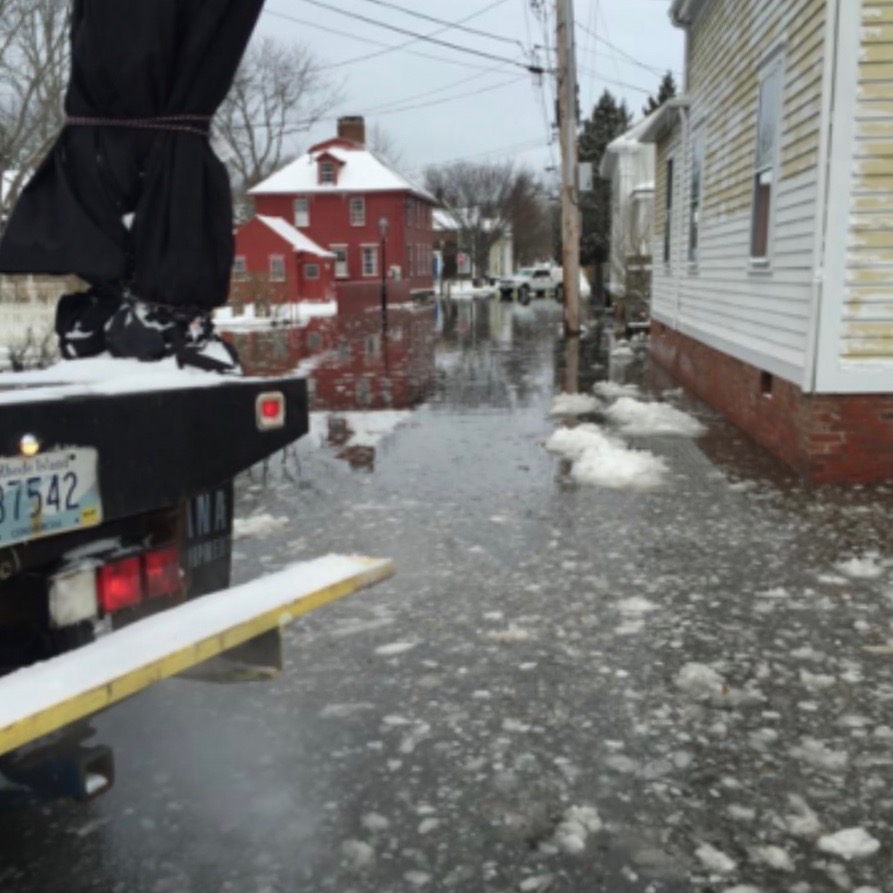
According to the report, in Rhode Island there are 5,028 residential properties that have substantial flood risk that are expected to have a collective loss of $13.3 million this year.
Over the next 30 years however, the Foundation says due to climate change, the expected losses could increase -- in some cases, dramatically.
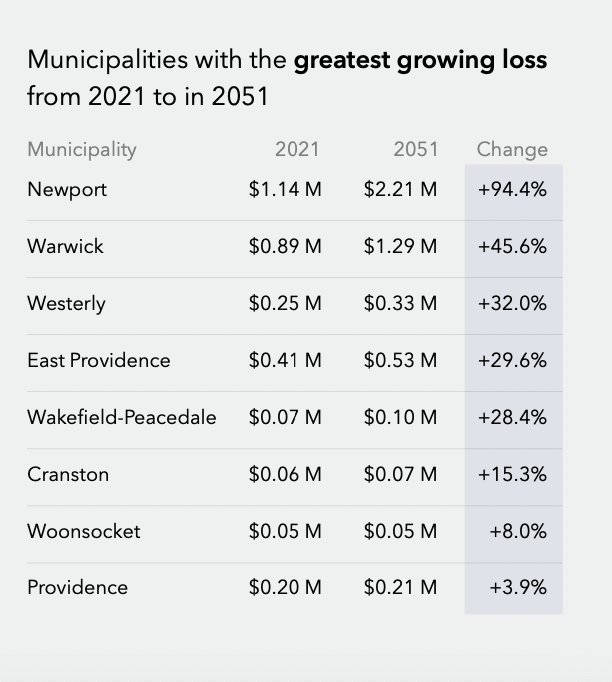
GET THE LATEST BREAKING NEWS HERE -- SIGN UP FOR GOLOCAL FREE DAILY EBLASTIn Newport, flood loss cost is forecasted to jump 94%, from $1.14 million in 2021 to $2.21 million in 2051.
By 2051, an additional 855 properties in the state are projected to experience financial loss from flood damage.
In total, the average expected annual loss per property is expected to increase 39% over the three decades -- from $2,647 in 2021 to $3,680 in 2051.
SEE MORE BELOW CHART
Insurance in Focus
For the 2,108 properties in Rhode Island within FEMA’s Special Flood Hazard Areas (SFHA), the Foundation calculated the average expected annual loss for structural damage per property to be $4,609 while the average National Flood Insurance Program premium for these properties is calculated to be $1,846.
If premiums were adjusted to cover current risk they would have to increase by 2.5 times. Homes inside SFHAs are mandated to carry flood insurance if they have a federally backed home loans.
“The financial implications are most pronounced for 1,636 properties [in Rhode Island] with extreme risk and structural damage, which have a $5,148 gap between their calculated NFIP premium and expected annual loss per property,” the report continues. “This added cost, if reflected in premiums, would have the most pronounced impact to home values.”
READ THE REPORT: Cost of Climate - America's Growing Flood Risk
The First Street Foundation found that there are nearly 4.3 million residential homes (1–4 units) across the country with substantial flood risk (1% annual) that would result in economic damage. The research allows for the calculation of an average annual loss (AAL) statistic for each residential property in the contiguous United States, a key metric used to estimate the dollar value of damage associated with flood risk on an annualized basis.
The Foundation found that while total expected annual loss for these properties across the U.S. is $20.0 billion this year, it grows to nearly $32.2 billion a year in 30 years—an increase of 61%—due to the impact of a changing climate.
Furthermore, the analysis demonstrates that if all of these homes were to insure against flood risk through the National Flood Insurance Program (NFIP) current pricing structure, those rates would need to increase 4.5 times to cover the risk. These patterns vary across the country, but consistently show an underestimation of economic flood risk in both coastal and inland regions.
The public availability of these data also gives state and local governments, as well as homeowners, advance insight into possible forthcoming changes in future risk-based prices insurance premiums.