


“Supersacks” Placed in Ten Mile River in East Providence to Assist Herring
GoLocalProv News Team
“Supersacks” Placed in Ten Mile River in East Providence to Assist Herring
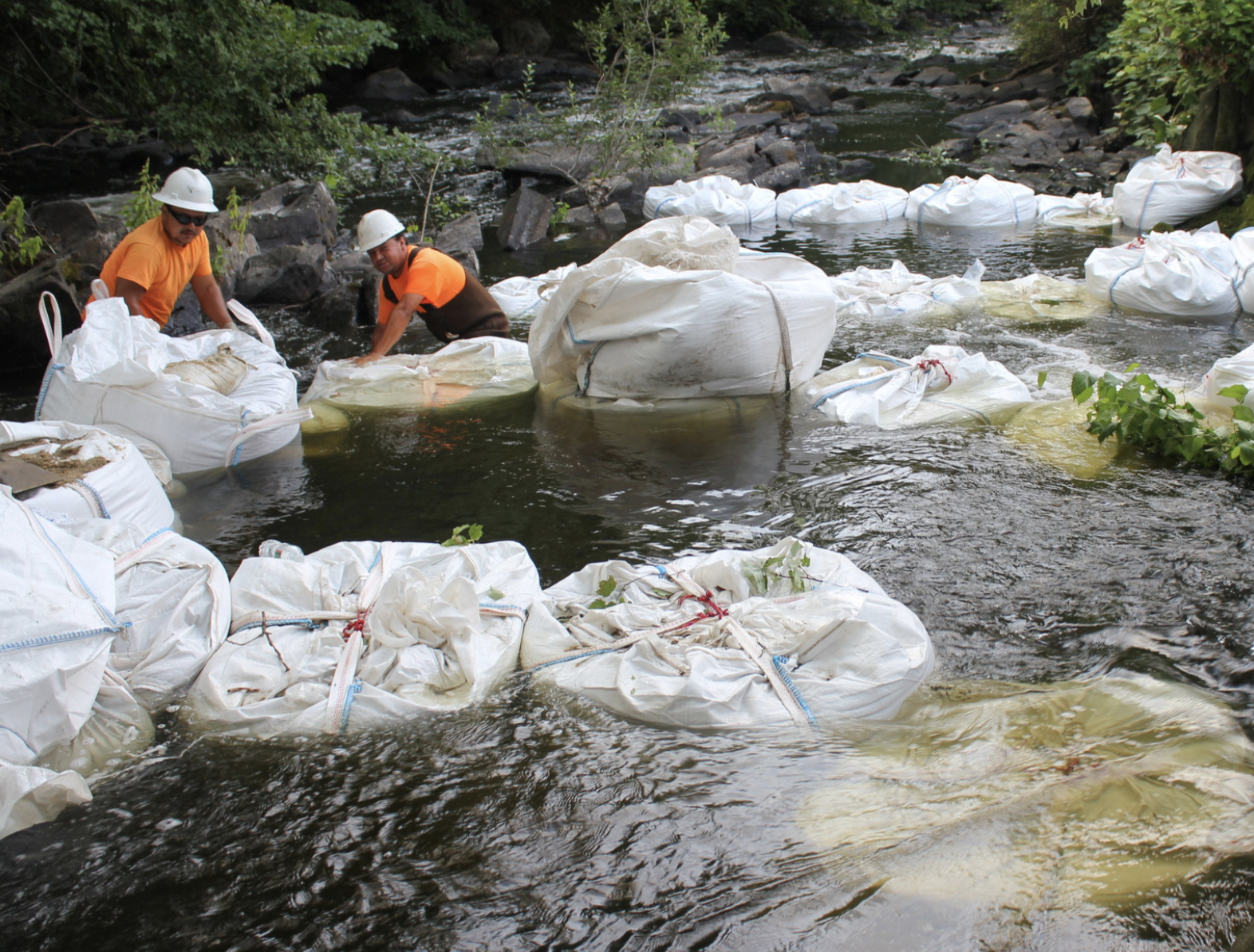
The Nature Conservancy in partnership with the U.S. Army Corps of Engineers, U.S. Fish and Wildlife Service, and RI Department of Environmental Management has installed four temporary weirs in the Ten Mile River near Hunt’s Mills.
Weirs are a low dam built across a river to raise the level of water upstream or regulate its flow and creating, in this installation, a de facto fish ladder.
GET THE LATEST BREAKING NEWS HERE -- SIGN UP FOR GOLOCAL FREE DAILY EBLASTAccording to The Nature Conservancy, “the weirs are serving as a full-size model that will help environmental engineers design permanent structures meant to help river herring navigate a rocky stretch of the river during their spring spawning run.”
The project was completed in August to take advantage of low water levels and to avoid fish migration. The total construction cost was $53,000.
The in-river model consists of dozens of sandbags and 30 sand-filled supersacks, each weighing up to 3,400 pounds. The sacks were lowered into the Ten Mile River by a special long-arm excavator capable of reaching 150 feet.
According to the Nature Conservancy, the four weirs created a series of resting pools, each one about six inches lower in succession. Engineers will track the volume of water moving through 3-foot-wide notches in the weirs and determine whether further adjustments are necessary to accommodate the bursting and sustainable swimming speeds of river herring.
The supersacks will be left in place through the Spring 2021 herring run to see how fish interact with the new structures at Hunt’s Mills.
The work follows on the construction of fish ladders at Omega Pond, Hunt’s Mills and the Turner Reservoir by the U.S. Army Corps and the R.I. Department of Environmental Management. While the ladders enabled river herring to return to Turner Reservoir to spawn, biologists have observed many fish struggling to overcome a three-foot-tall bedrock ledge just below Hunt’s Mills. Significant delays at this spot cause fish to expend energy unnecessarily and likely reduces the number of herring that can ascend the ladders to complete their migration.
The Army Corps considered several alternatives to address the natural obstacle to fish passage, but the Ten Mile River’s rocky and irregular bottom, and associated quickwater rapids, are difficult to replicate in a computer model. The USFWS Fish Passage Engineering Group, under contract with The Nature Conservancy’s Rhode Island chapter to assist with fish passage projects across the state, was integral to the design of the temporary weirs and will continue to monitor their performance.
To expedite construction, the Army Corps and RIDEM asked The Nature Conservancy to manage the project, and TNC awarded a construction contract to SumCo Eco-Contracting of Peabody, Mass. through a competitive bidding process.