


Zelensky, Ukraine, and a Foreign Policy of Prudent American Realism - Mackubin Owens
Mackubin Owens, MINDSETTER™
Zelensky, Ukraine, and a Foreign Policy of Prudent American Realism - Mackubin Owens
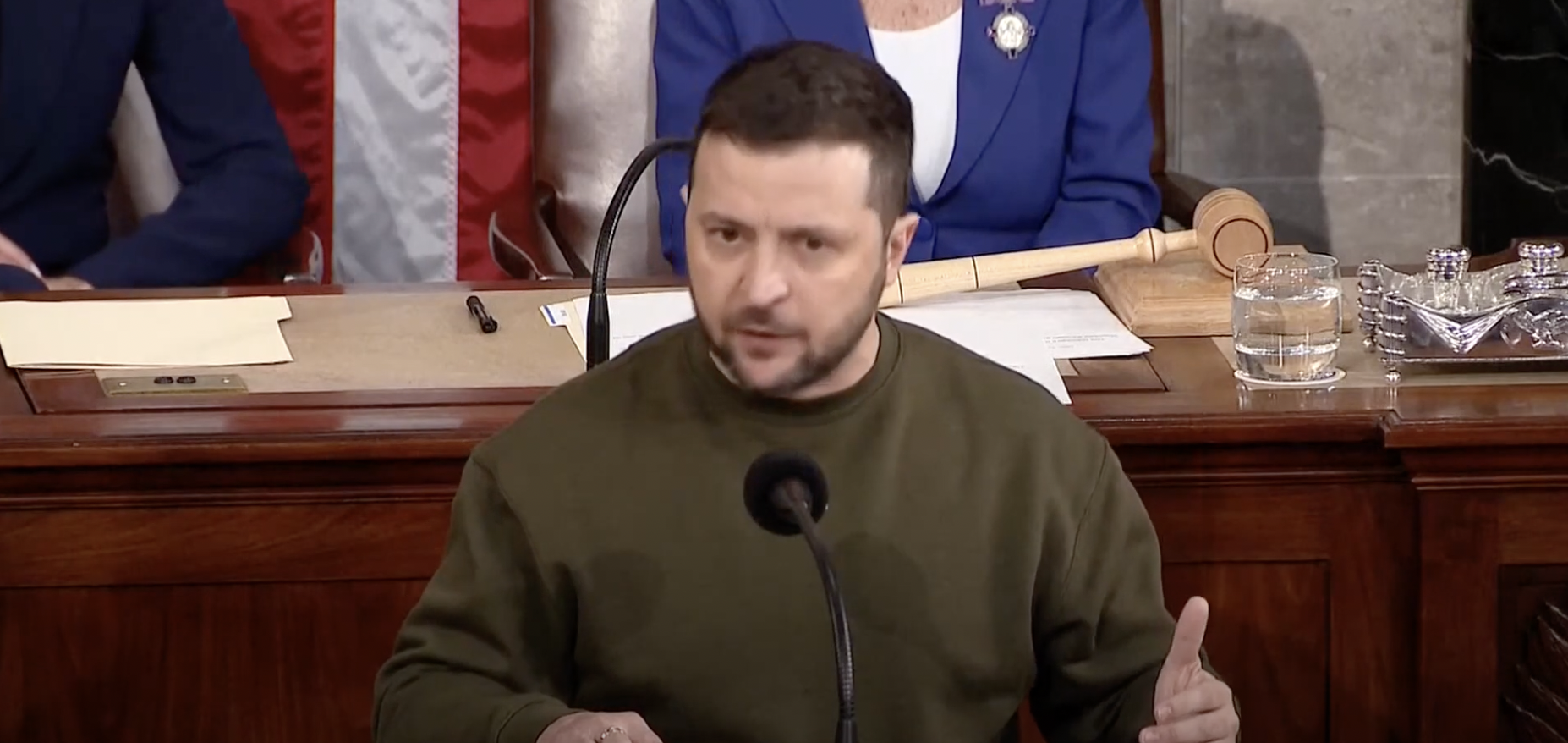
It is generally conceded that Ukrainian President Volodymyr Zelensky’s recent address to the US Congress was an excellent piece of rhetoric. It has been called inspiring, “Churchillian” even. It was, of course, a plea for additional US support for embattled Ukraine, but many saw it as much more: a call for America to remember its “mission” in the world. In the words of David Frum in The Atlantic, “He came to Washington to ask for assistance. But above all, he came to Washington to recall Americans to themselves. He came to say, My embattled people believe in you. Embedded in his words of trust was a challenge: If we believe in you, perhaps you can again believe in yourselves?”
GET THE LATEST BREAKING NEWS HERE -- SIGN UP FOR GOLOCAL FREE DAILY EBLAST
Zelensky will no doubt get his aid. But we should perhaps dial down the rhetoric. I have argued on behalf of a US foreign policy/grand strategy that I call Prudent American Realism. This approach links American principles with prudence, which, as Aristotle argued, is the virtue most characteristic of the statesman, requiring as it does the ability to choose the best means for achieving good ends.
American foreign policy has always been most successful when it fused the features of traditional realism—power and security—with the preservation of American principles. George Washington articulated this unique American realism in his Farewell Address: “If we remain one People, under an efficient government, the period is not far off, when we may defy material injury from external annoyance; when we may take such an attitude as will cause the neutrality we may at any time resolve upon to be scrupulously respected; when belligerent nations, under the impossibility of making acquisitions upon us, will not lightly hazard the giving us provocation; when we may choose peace or war, as our interest guided by justice shall Counsel.”
Washington’s formulation calls for balancing interest and justice. While in terms of justice, we should offer Ukraine as much support as we can afford, that support is necessarily limited by our own interests. One such interest is to avoid being drawn into an unnecessary war. Another is to be able to fight a war if it should come.
Regarding the first, as I recently wrote in GoLocalProv, “The desire to aid Ukraine in repelling Russian aggression is understandable, but our policymakers have to ask themselves if we, like the European leaders of 1914, are sleepwalking into a war, the possible consequences of which are disproportionate to US interests, especially in light of threats to these interests in the Pacific.”
Regarding the second, by supplying weapon systems to Ukraine, we have depleted our own stockpiles of weapons such as the High Mobility Artillery Rocket System (HIMARS) and air defense systems. This has created problems for the United States, especially in the Indo-Pacific region where we face our primary strategic challenge from China. For example, the Japanese newspaper Nikkei reported in early October that some parts of planned joint drills between Japan's ground forces and US Marines were canceled due to a lack of shells for the US HIMARS launching systems.
The problem with Frum’s responses to Zelensky’s speech and many others in a similar vein that invokes America’s “mission” is the implied call for an unrestrained foreign policy, the very antithesis of prudence. It is interesting to note that calls for America’s “mission” began with the rise of Progressivism and Woodrow Wilson’s call for US entry into World War I to “make the world safe for democracy.” Although US interests were not paramount during that conflict, they certainly were at stake in World War II and the Cold War and our use of military power was fundamentally prudent, but can we say the same for Iraq and Afghanistan, where we overreached in an attempt to fulfill the American “mission” of spreading democracy?
An especially repulsive aspect of the US debate over aid for Ukraine is the attempt by many in the press and government to shame those deemed insufficiently enthusiastic about spending additional billions to support Ukraine. Such dissidents are dismissed as unpatriotic, even as Putin supporters. Indeed, many who attack their fellow citizens for opposing more aid to Ukraine seem willing to support a US-NATO war against Russia, although they would never admit it public. Of course, most of them have never experienced the horrors of war themselves.
The Biden administration has so far refused to help negotiate an end to the Russo-Ukrainian conflict, despite the vast suffering of the Ukrainian people and the possibility that the United States might be drawn into a war with Russia. Members of the administration have been quoted as expressing hope that Putin’s failure will lead to the collapse of Russia. That is a dangerous game indeed, so dangerous that it suggests a more sinister purpose on the part of the administration: to keep the foreign policy pot boiling to divert attention from domestic failures.
History illustrates that wars have a unifying national effect, at least in the beginning. We saw this with Vietnam, Iraq, and Afghanistan. The theme was illustrated by Shakespeare in Henry IV, Part 2. The dying Henry IV, who usurped the English crown and whose reign has thus been wracked by civil strife, summons Prince Harry, the future Henry V, to his bedside. Among other things, he advises Hal to “busy giddy minds / With foreign quarrels….that action hence borne out / May waste the memory of the former days.”
Henry V takes his advice, invading France on the basis of a questionable claim to the French crown. The unifying effect of the war is apparent as it trumps the previous divisions among the English, Welsh, Scots, and even the Irish. The culmination of the effort is the English victory at Agincourt, where King Henry famously invokes his “band of brothers…we few, we happy few…”
Ukraine has the right to appeal to the United States for assistance in repelling Russian aggression, but American citizens have a legitimate expectation that Ukrainian interests do not come at the expense of US interests. Zelensky’s stirring rhetoric notwithstanding, giving Ukraine a blank check, as some wish us to do, is the very opposite of a prudent US foreign policy.
There is something to be said for returning to our pre-Wilsonian Progressive foreign policy. Such a policy was nicely summarized by Secretary of State John Quincy Adams on Independence Day of 1821: “Wherever the standard of freedom and Independence has been or shall be unfurled, there will [America’s] heart, her benedictions and her prayers be. But she goes not abroad, in search of monsters to destroy. She is the well-wisher to the freedom and independence of all. She is the champion and vindicator only of her own.” Far from being a plea for US isolationism, it is a call for prudence.