


The Growing Threat of the Asian Tiger Mosquito in RI — Impact on Humans and Pets
GoLocalProv News Team
The Growing Threat of the Asian Tiger Mosquito in RI — Impact on Humans and Pets
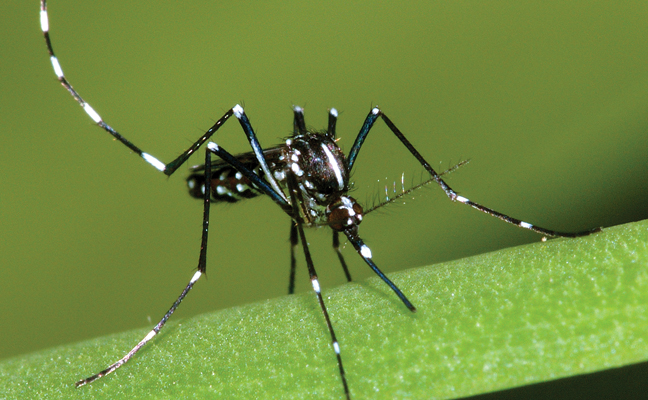
The Asian tiger mosquito is increasing in Rhode Island. This is not the first year of detection, but it is an ever-growing threat in the region.
“The Asian tiger mosquito is an aggressive biter that feeds primarily during the day and has a broad host range including man, domestic and wild animals, and birds. It is a potential vector of encephalitis, dengue (all four serotypes), yellow fever, and dog heartworm,” according to researchers at UC Riverside.
GET THE LATEST BREAKING NEWS HERE -- SIGN UP FOR GOLOCAL FREE DAILY EBLAST“West Nile virus has been detected in this species in the eastern U.S. This mosquito is a competent vector of LaCrosse encephalitis and eastern equine encephalitis viruses,” reported UC Riverside.
GoLocal spoke with Michael Healey at the Rhode Island Department of Environmental Management about the threat and how the agency monitors the species.
Is your team tracking the spread of the Asian tiger mosquito?
Yes, we’ve confirmed its presence in RI. The normal surveillance traps used by DEM are light traps. The Asian tiger, however, is active during the daytime, so light traps are not all that effective at capturing it. The DEM mosquito program has started to use BG-Sentinel traps and ovitraps, which are more effective at capturing this species.
For the last three or four mosquito seasons, the Asian Tiger Mosquito has become more prevalent in urban environments in our state. It is expected to be common again this season. It is notable as a daytime biter encountered in shaded backyards in urban settings in RI. This species is established throughout much of the southern and eastern United States. It has a striking black and white pattern evident to the naked eye (please see attached picture).
How has it spread to/in RI?
The tiger mosquito is native to Asia. It is believed the species spread to the Western Hemisphere because of the international trade in used tires. The United States imports millions of tires from Asia due to the high rubber content of Asian tries, for remanufacturing purposes. Tiger mosquitoes are closely associated with used tires, which are used as sites for egg deposition and larval development.
It is likely that tires imported to Houston from Japan in 1985 brought tiger mosquitoes to the United States. The trade of used tires within the United States has dispersed the mosquito throughout the eastern and midwestern states. Like other flying insects, adult mosquitoes are not tied to the area where they were produced and spread naturally. Wind may be a factor. People can aid mosquito spread by inadvertently transporting adult ATMs in cars.
What is the danger?
Although it is known to transmit several diseases including West Nile Virus, thus far, based on lab experiments, we have not seen any evidence that it has contributed to virus transmission in Rhode Island.